Self-hosted · AI-native · Crash to fix
Your software
reports its
own problems.
TicketMan AI is a self-hosted software support engine. A drop-in SDK sends errors and their full context straight from your applications, and AI connects each incident to its history, your knowledge and your customers. Bring your own models, or run fully offline.
A helpdesk stores what the customer said. TicketMan AI gives people and AI agents the context they need to resolve the problem.
- Drop-in SDK (.NET / Node / Python)
- Runs fully offline
- No per-seat tax
01 · Your software speaks
Errors report themselves, with their context attached.
An error breaks your application. The drop-in TicketMan Diagnostics package (NuGet for .NET, npm for Node.js, PyPI for Python) catches it and hands it to TicketMan AI, which routes it to an agentic dev server. There it becomes a patch, ships back through your CI/CD, and the software that broke is whole again.
02 · TicketMan understands
It's not just a ticket.
It's an incident with context.
The valuable part isn't the ticket. It's the context around it: what the software did, what it has done before, what your team already knows, and who it happened to. TicketMan AI brings information that normally lives in five separate systems into the incident itself.
A ticket, anywhere else
“Customer ABC says the order failed.”
That's the whole ticket. No application, no version, no stack trace, no history. Support asks the customer questions. Engineering asks support for logs. Everyone starts from zero.
The same incident in TicketMan AI
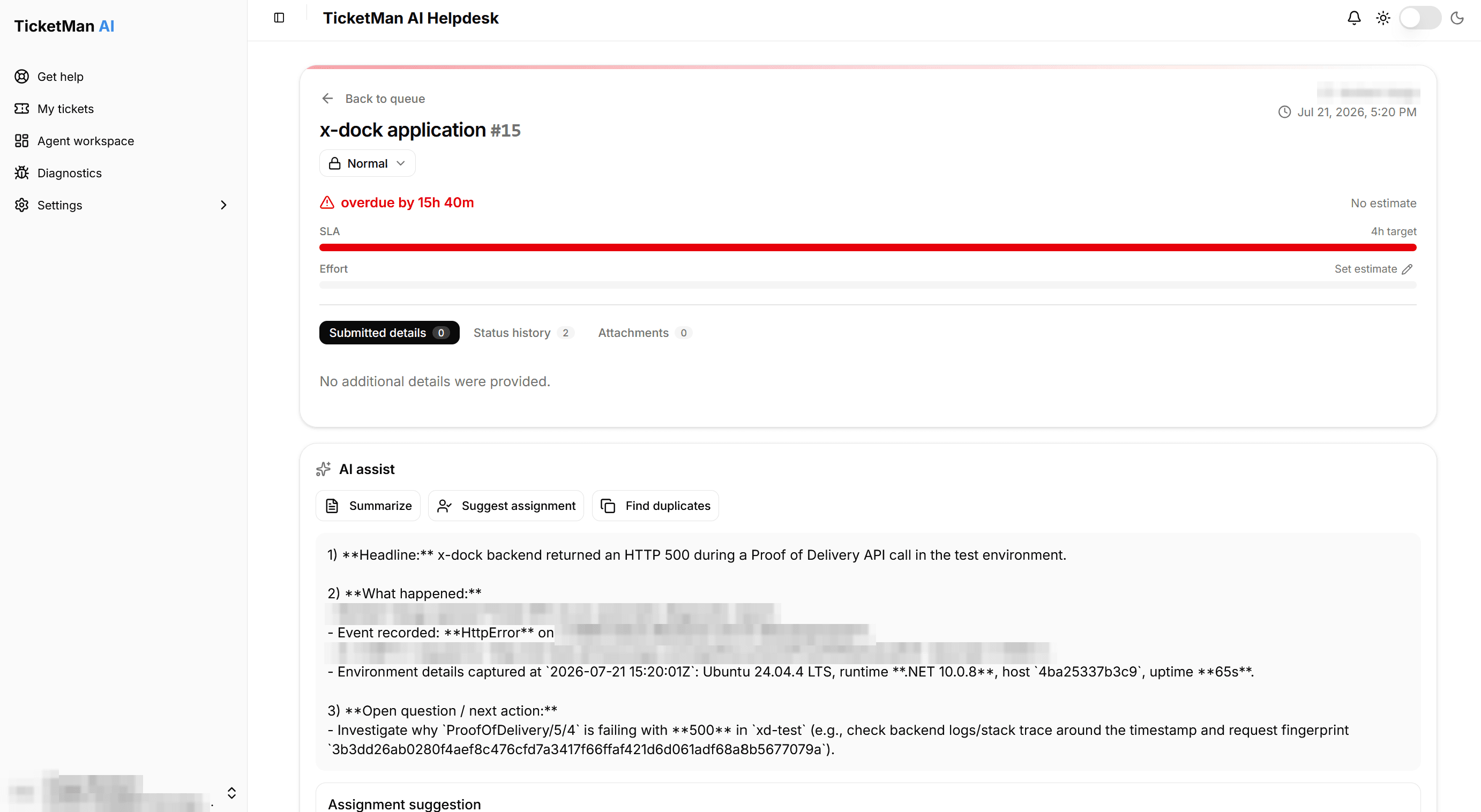
No complaint yet. The incident filed itself.
Customer ABC hasn't even noticed the crash. You ship the fix before the next claim lands.
- Applicationorders-api · v2.14.1
- Environmentproduction
- ExceptionNullReferenceException · full stack trace
- RequestPOST /api/orders · 500
- Breadcrumbsthe last log events before the crash
- Occurrencesgrouped with 13 earlier reports
- Similar incidents2 linked
- Knowledgerelated runbook, cited
- Customerfull conversation history
Captured by the SDK, connected by AI. Nobody has to go asking for logs.
03 · Your team acts
A help desk on day one.
A support engine when you are ready.
Support and engineering act on the same enriched incident: AI drafts and summaries for your agents, and on the Dev Server plan, coding agents that can pick up the fix. The help desk part is complete from the start: your team does less, your customers wait less.
of questions never become tickets
Half the questions never become tickets
Most support requests are things you’ve already answered a hundred times. When someone starts to ask, TicketMan AI gives them the answer first, pulled straight from your documents, with a link to exactly where it came from. Simple questions get solved in seconds; your team only handles the ones that actually need a human.
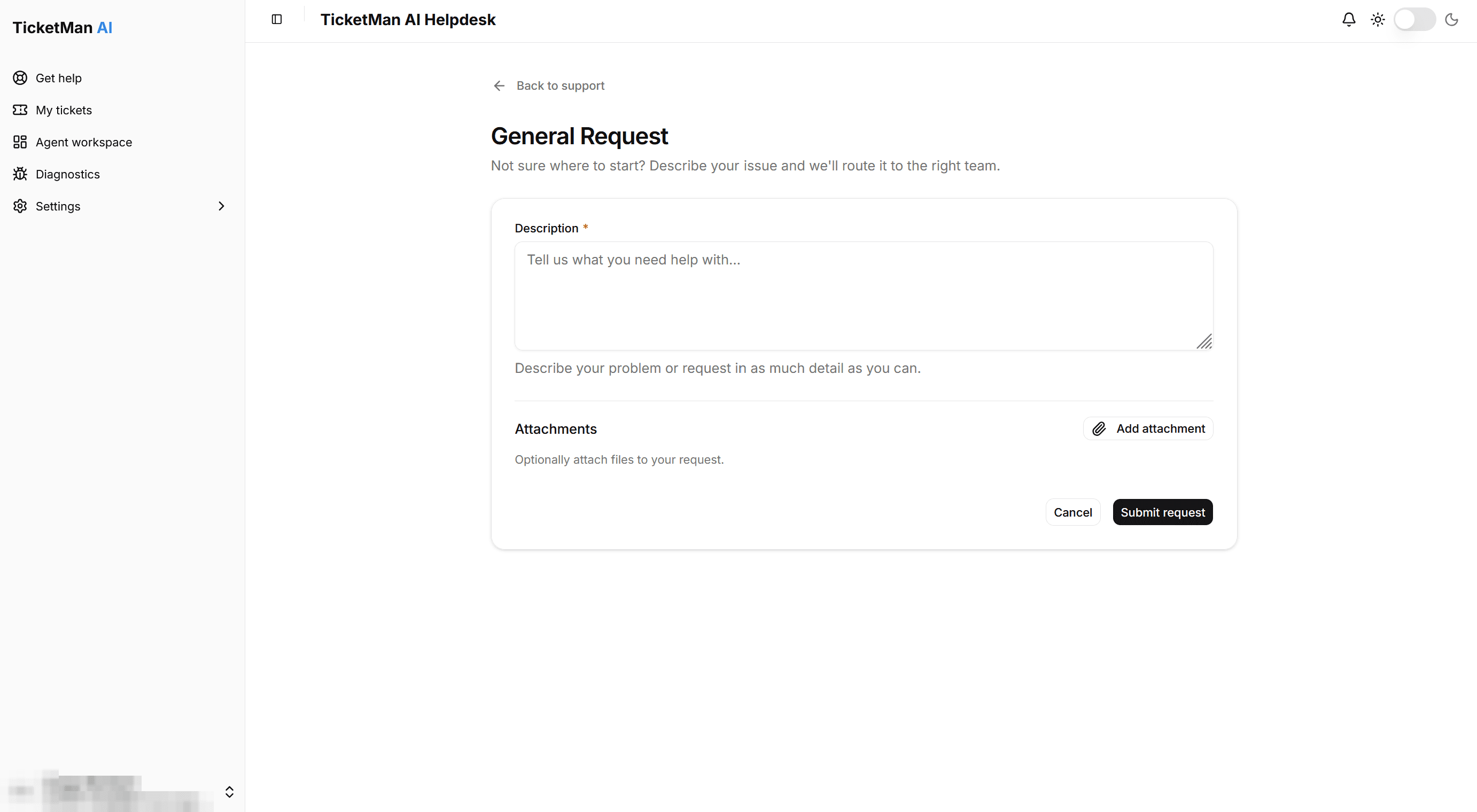
channels, one tracked queue
Meet people where they already are
Your customers and staff don’t have to learn anything new. They send an email or a Teams message like they always do, and it automatically becomes a tracked, organized request, routed to the right person. Nothing falls through the cracks.
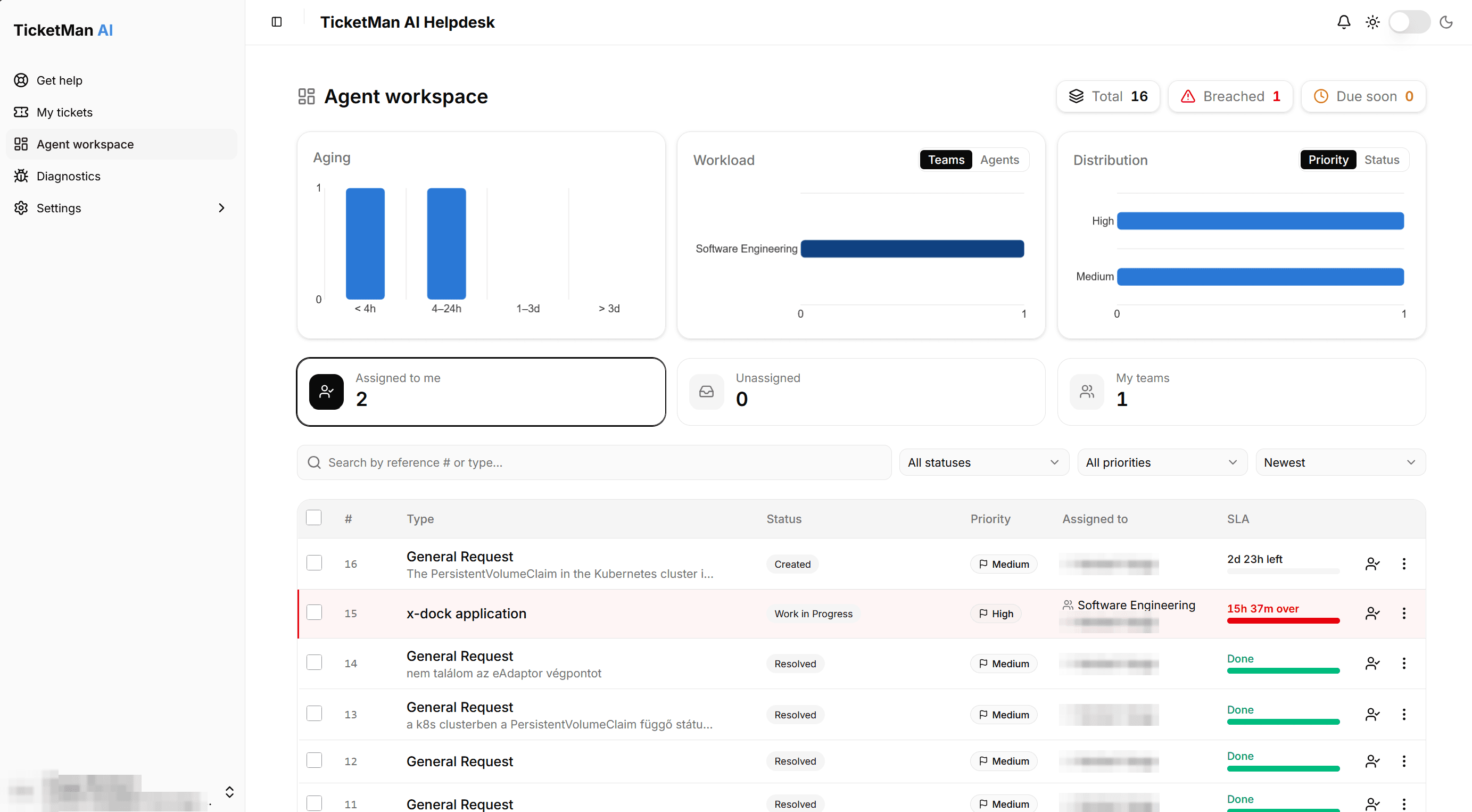
updating in real time
A control room for your support team
Your agents get one clean screen showing everything live (what’s urgent, what’s overdue, what needs attention right now), updating in real time. They spend their day solving problems, not hunting for information.
04 · You own the intelligence
Intelligence you own.
Not intelligence you rent.
Most ticketing tools rent AI back to you: their model, their prompts, their bill. TicketMan AI gives you the keys: bring any of five models, or run one entirely inside your own walls, disconnected from the internet, so nothing ever leaves the building. No per-seat AI tax. Models will keep changing; the context and workflow around them stay yours.
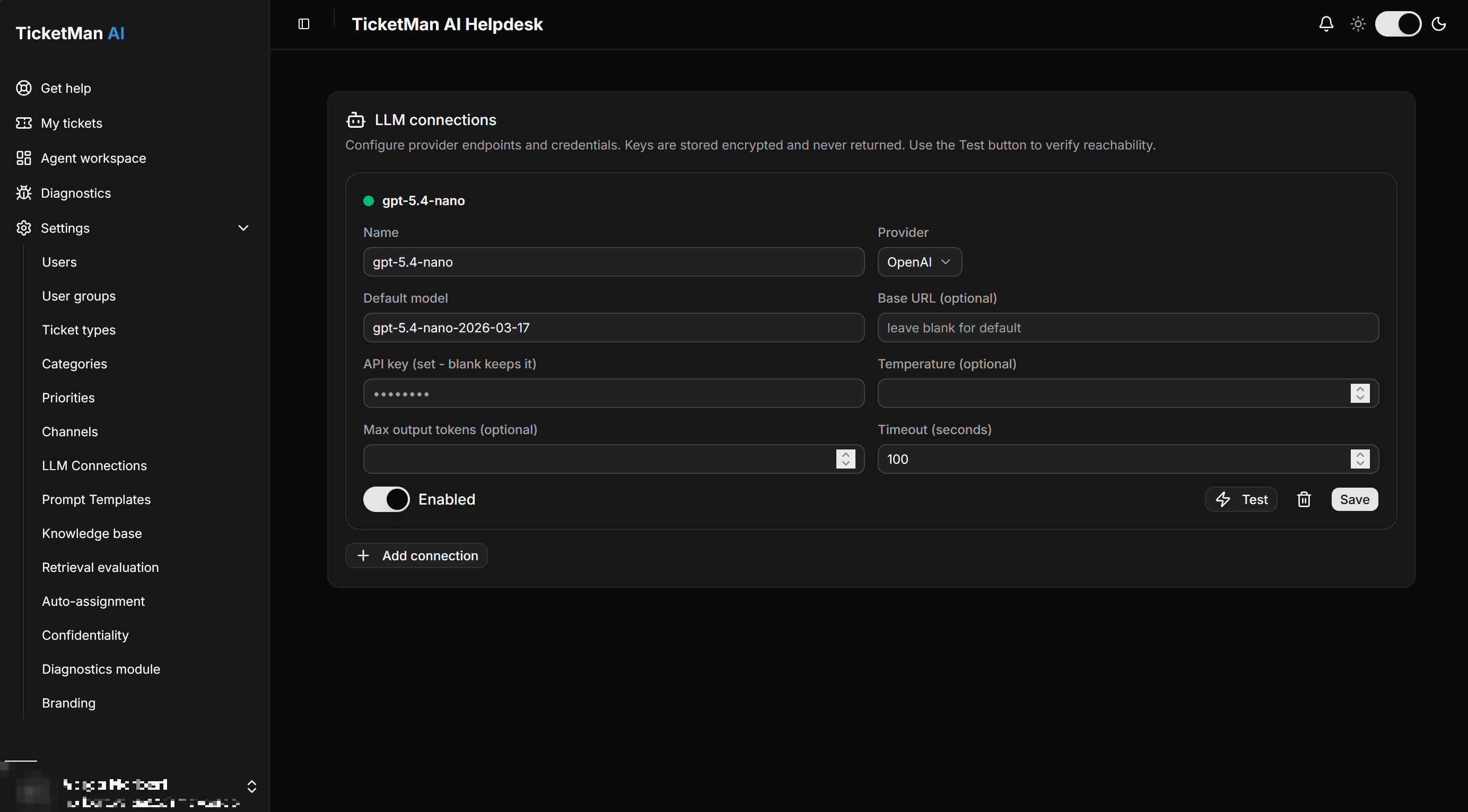
Bring any model, or no cloud at all
- OpenAI
- Azure OpenAI
- Anthropic
- Grokx.ai
- Ollamalocal, nothing leaves your network
Each function picks its own connection and model, a per-task cost/quality dial no SaaS competitor exposes.
What it does for agents
Summarize
Turn a long ticket and its back-and-forth into a brief you can read at a glance.
Draft replies
A ready-to-send response, grounded in the conversation. Your agent reviews and sends; it never sends itself.
Beautify
Rough agent notes become a clear, professional message in one click.
Suggest assignment
Recommends the right team or person for the ticket.
Detect duplicates
Flags repeat tickets so two agents never answer the same thing.
- Every answer cites its source
- Says “I don’t know” instead of bluffing
- Human-in-the-loop, nothing auto-sends
- Your keys, encrypted
- Edit every prompt
- See the cost of every call
Rent vs. own
Owning the system beats renting one.
The big platforms hold your data, your AI and your bill. TicketMan AI runs inside your own walls:
Rented platforms
TicketMan AI
Your documents, conversations and confidential data live in someone else’s cloud. Their compliance becomes your liability.
Your data stays yours. Everything runs on your own servers or private cloud. For hospitals, banks and government, that’s the difference between “yes we can use this” and “no we can’t.”
Weeks of installation, then you’re locked to one place. Moving environments means a rebuild.
Fully containerized. Stand up a private copy in seconds, not weeks. Run in public cloud today, move to private tomorrow. Same system, no re-installation.
You must send your information to their AI, on their terms. There is no opting out.
The AI works your way, even completely offline. Run it entirely inside your own walls, disconnected from the internet, so nothing ever leaves the building.
You pay more every time you add a team member. AI features cost extra on top.
No per-person price tax. Growing your team shouldn’t grow your bill: one flat price, AI included.
AI was bolted onto an old system to answer tickets a little faster.
AI isn’t a bolt-on. It’s the whole point, built from the ground up to prevent the ticket in the first place.
Answers you can trust
No guessing. No making things up.
An answer is only useful if you can rely on it. TicketMan AI grounds every response in your own documentation, and is honest about the limits of what it knows.
Every answer points to its source
Each response links back to the exact document and section it came from, so nobody’s guessing, and nobody’s taking it on faith. If you want to check, the source is one click away.
It says “I don’t know” instead of bluffing
When TicketMan AI doesn’t actually know, it says so and hands the request to a person, rather than making something up. No confident-sounding fiction, ever.
Accuracy you can verify over time
You can check how reliable the answers are as your documentation grows and changes, so trust isn’t a launch-day promise; it’s something you keep proving.
Everything else it does
Built to fit the way your organization actually runs.
Scales without limit
From a product FAQ to a nuclear plant’s manuals
Drop in thousands of pages and it stays fast and accurate; the more you give it, the smarter your support gets. When a procedure changes, upload the new version and it switches over instantly, with no downtime.
Customer portal
Serve outside customers safely
Turn on the customer portal to give external customers a place to submit and track requests. It’s a completely separate, locked-down front door, so the outside world never touches your internal systems.
Shape it to how you work
Build your own forms, no programmer needed
Drag and drop to build request forms. Set up your own categories, priorities, and process steps to match the way your organization actually runs.
Up and running in seconds
Runs anywhere, drops into what you have
The whole system is packaged to run anywhere (cloud or your own private copy) in seconds, not weeks. No lengthy installation, no complicated setup. Start small and grow, or move it between environments without ever re-building it.
Questions
A self-hosted ticketing system, answered.
- What is TicketMan AI?
- TicketMan AI is a self-hosted software support engine. A drop-in SDK sends errors, crashes and their diagnostic context into the system, where AI groups them and connects each incident to its history, your knowledge and the customer it happened to. From there your support team, an engineer, or an agentic dev server can resolve it, all on your own infrastructure.
- How does the self-healing support loop work?
- The Diagnostics SDK captures an error and forwards it to TicketMan AI, which groups and pre-categorizes it into a ticket. On the optional Dev Server plan the ticket is handed to an agentic coding model such as Claude Code or Codex, which proposes a fix and opens a pull request. A human engineer reviews it, or it auto-approves, and your CI/CD ships the update. The loop closes.
- Is TicketMan AI self-hosted?
- Yes. TicketMan AI is fully self-hostable and runs on your own servers or private cloud. Your database, your tenant, your keys. Point the AI at a local Ollama model and no ticket content ever leaves your network.
- Can the AI run offline?
- Yes. You can bring your own model provider (OpenAI, Azure, Anthropic, Grok) or run a fully local model with Ollama, so the AI can work entirely inside your own walls.
- How much does TicketMan AI cost?
- Individuals and open-source contributors are free forever. Companies under 200 employees whose supported apps have fewer than 50,000 users pay one flat 149 dollars per month. Larger and regulated organizations get a custom enterprise quote.
- What is the Diagnostics SDK?
- TicketMan Diagnostics is a drop-in package for .NET, Node.js and Python applications. Install it, set two environment variables, and unhandled crashes and errors are reported to your TicketMan AI suite for grouping and AI root-cause analysis. Without a configured endpoint it is completely inert, with zero overhead.
Close the loop on your support
Ship the fix before
the next ticket lands.
Self-host TicketMan AI on your own tenant, bring your own models, and let the loop run as far as you trust it. Book a demo and we'll walk you through the platform end to end.
Book a demo · we'll reach out to schedule · no spam